Monday, July 12, 2010

Dramatic Weather, Beautiful Old Cars & British Accents

Street in Bellême

We're in the middle of a heat wave in France, called a canicule over here. I love the word, but not the phenomenon. Thankfully our old house remains cool. As long as you stay inside, you can remain comfortable. Thick stone walls are efficient; in the winter they hold the heat generated in the chimneys, while in summer they stay cool.

On warm summer nights we often have thunder and lightening storms. Sitting in our window seat in our third floor apartment, we have a fabulous view over miles of green valleys that fall away all around us. When there is an electrical storm, we can sit and watch our own personal light show. The one this week lasted for a couple of hours and was particularly fierce. When a bolt of lightening lit up the sky, we cried out simultaneously. It was mesmerizing.

There are several kinds of lightening. We saw forked lightening, the kind with fingers:


This is clearly not a view from our window, but such a great photo!

 streak lightening, a single thick bolt:


 and a lot of sheet lightening, where the whole sky lights up:

***

This week was long anticipated. The Le Mans Classic Car Race, a biennial event, took place over four days at the track in Le Mans. If the number of phone calls we received for bookings is any indication, it is far and away the most popular event on the Le Mans calendar. We turned dozens of people away. Our clients have been planning this extended weekend for a long time; all four of our rooms have been reserved for this week since last summer.

The Classic is also a 24 hour marathon, but just for the spectators, not the individual cars and drivers. There are eight three-hour races which stretch over the course of the weekend. Cars built from 1923 (when the 24 Hour Le Mans race was initiated) to 1979, are eligible to race, but only makes and models which have once competed in the 24 hour Le Mans race itself. Similar vintages of cars race against one another. This is one of the biggest classic car events in the world and 7000 cars are on display, not to mention the cars racing and all the gorgeous cars driven by the spectators themselves. It's a real treat to the eyes to be on the road this time of year as so many beautiful automobiles are on view everywhere.

3 of the 4 sports cars driven by our guests, two Porsches and a Jaguar. Not pictured is the Aston-Martin.

All our clients are British. I am quite sure that the English make up the greatest part of any car event in Le Mans; they are simply car-mad! Roy and Julie have come every year that the Classic has been offered. Our other three rooms were taken by a group from an Aston-Martin car club. Mike and Sue stayed with us last fall to make their arrangements for this week. It is their first time at this particular event, although they are 24hr regulars. They brought their fellow enthusiasts, John and Terry, and Dave and Tina. They are a very lively and enthusiastic crowd.

Mike and Dave dressed as 50s car mechanics, complete with ascots and sporty hats

Spectators of the race were invited to dress in appropriate period costumes and were not allowed in certain areas of the course with modern clothing. 

I like to take photos of pretty old cars. They look good in front of our house! There are more classic cars on the road this time of year, but they can be seen at any time. There are many active car clubs in both England and France and when the weather is good, they like to take drives on our country roads, which are quiet, picturesque and curvaceous. Perfect driving conditions. Lovely old vehicles often pass through the village and stop for a look around. My favorite vintages are always the really old ones, from the 20s and 30s.

Lotus

Bentley


Alfa-Romeo

***

Our four couples stayed four nights, so we've had a chance to get to know them and vicariously share their enthusiasm. I was struck by how many different accents there were between them. For such a small place, English has a lot of regional linguistic variations. In our group of eight, we had one northerner, who sounds softly Scottish, a woman from Ireland with that lilting Irish rhythm and others from various regions east and west. Mike describes himself as from a working class background, and his wife Sue as from a white collar family, and their accents are markedly different. Mike doesn't pronounce "th", which is also a hard sound for the French. While we might say "with," a French person would say "wiz" and Mike says "wif". Do Californians have accents? I guess it all depends on your perspective. But surely if we do, we only have one for the entire region, which is, after all, bigger in area than Britain. England has many noted variations.

***

The wisteria is in bloom for the second time, almost as effulgent as the first one some weeks ago. The yellow rose that climbs the front of the house with it, is more or less in constant bloom throughout the warm season. The lavender, which borders our front beds, is out of control. We keep having to move the tables further into the middle of the terrace as the flowers take up more and more lateral space. The bees are gorging themselves and we are enjoying the fragrances which mix and mingle in the warm summer evening air. Our butterfly roses have finally established and asserted themselves. They are among my favorite flowers, for their happy habit of turning different shades of apricot and rose during their brief bloom. 

The dahlias in the upper garden are now in their full glory. Dahlias may not be terribly posh flowers, but they are so faithful, enduring and generous. They provide us with cut flowers throughout the summer and fall.  They come in so many forms and colors. This year we have several white varieties. I appreciate them everyday.


For Janet: neighbors' new apricot house color, lemon yellow boulangerie in the background

Monday, July 5, 2010

Week 6: Working in the Studio, Playing in the Sand

 Monique's Garden


This week was especially hot, sandwiched between two days of rain to cool things down. On the way to the garden one morning, not knowing if it was necessary to water or not, we met M. Villette, his daughter Martine and her friend, the woman who walks her burro (without a lead) through the village. They were sitting on plastic buckets, harvesting baskets full of red currants. The night before Martine had rung our doorbell just before dark and passed two handfuls of fresh raspberries through the front gate, so we knew she was in town visiting her parents.

"Bonjour, John," said Martine. She always calls Rick the wrong name, but it's gone on for too long now to correct her.

We talked for a few moments about the chances of rain when Martine's friend suggested:
"Demandez de M. Crapaud."

Apparently a large toad (un crapaud) has been living in the same place in their garden for five years, and toads can predict the weather, (and earthquakes for that matter, although that is not an issue in our part of the world). M. Villette lifted the lid to the culvert where the toad makes his home, and I guess M. Crapaud said it was going to rain, since shortly after watering the flowers, we got quite a nice shower. We should have listened to him, but we don't speak his language.

 ***
Speaking of creatures, the owls that live in the castle tower have been particularly active this week. A pair of beautiful snow white owls have inhabited the castle longer than we have been in residence, and they can often be seen, just as dusk falls, gliding over the castle grounds and wall and passing over our rooftop. The cry they make is between a moan and a screech, and if I were a mouse, that sound would send shivers of dread down my little spine. It is such a mournful call, but one that I love hearing reverberate through early summer evenings.

***

At the beginning of this week, Georges spent two days in the studio printing photos of a lovely Indian girl he had met at an orphanage in Delhi. She is ten years old. The woman who heads the NGO that hired Georges to take photos of the institution was on her way back to Delhi this week, and Georges wanted to send along the girl's portrait as a gift.


We are very happy to have Georges share the studio with us from time to time. He is an entertaining and pleasant addition to our lives, and very easy to have around. He regaled us with stories this time of his childhood. His father owned a restaurant at Versailles when he and his six other siblings were growing up. Their residence was on the Palace grounds and at night, when all the tourists left, his father would take the large key and lock them out and the family in and Georges' family had the entire grounds to themselves.

Georges' eleven year old daughter Leyla came along to take a course from me while her father was doing his own work. 


When Georges originally proposed this idea, I was slightly skeptical. I wasn't sure that etching would be something a child would be interested in or even capable of. It has a very fussy side to it, especially aquatint, which requires a certain amount of concentration and the ability to think backwards. Instead it turned out that Leyla was a real natural and enjoyed every minute of the process. She is very patient, creative and focused. I started her out with dry point, which doesn't require using an acid to bite the plate. She learned very quickly. On the first day she made a plate in several stages, inking and taking a proof after each change. In the end she had a sweet landscape with a tree, lake, butterfly, cloud and sun. She printed it several ways, in monochrome, a la poupée and with chine collé, like her father uses. It was a real pleasure to work with her. 


Since Leyla was such an apt and enthusiastic student, I decided to introduce her to aquatint on her second day. With aquatint, one works with tones, rather than just line. Leyla wanted to put some text into her design, which is quite complicated since one has to work in reverse on the plate in order for the words to read properly on the print. I was particularly impressed that she had arrived in the morning with a plan for what she wanted to accomplish during the day. She worked very hard to create a drawing, first on tracing paper, and then transferred to the plate with carbon paper. She had created a little shop window full of cakes and breads. She named her shop "The Leyla". (She is a good student of English at school.) She etched the drawing onto a plate and then carefully, and in four steps, added her aquatint tones. A plate like hers takes several hours of work to realize and there is no proof taken until the plate is complete. It seems a very advanced technique for someone so young, but she became an instant pro. All of us were impressed with her charming results.


Leyla and Georges plan to return at the end of July to take up where they left off.

***

We had an opportunity to go to the north coast this last weekend. Emily is touring with her theater company in the Dordogne and Brittany, performing their new cabaret Improbable Aïda. Quinn is staying in Paris with dad. However, Jos had his own show, The Art of Laughter, to perform on the weekend in Le Havre and invited us along to watch the boy during performances. That seemed irresistible, so we blocked out the days and took advantage of his offer. We had never seen Le Havre, and were enticed by the prospect of a couple of days on the beach. The drive north took a little under three hours. 

Le Havre was occupied by the Germans during the war and completely flattened by Allied bombs. There is almost no building remaining from before the 1940s. UNESCO has designated Le Havre a World Heritage Site: 

The destroyed area was rebuilt according to the plan of a team headed by Auguste Perret, from 1945 to 1964. The site forms the administrative, commercial and cultural centre of Le Havre. Le Havre is exceptional among many reconstructed cities for its unity and integrity. It combines a reflection of the earlier pattern of the town and its extant historic structures with the new ideas of town planning and construction technology. It is an outstanding post-war example of urban planning and architecture based on the unity of methodology and the use of prefabrication, the systematic utilization of a modular grid, and the innovative exploitation of the potential of concrete. 

The results of the reconstruction are strikingly handsome.

We also spent a lot of time on the beach, which is clean and expansive, so one never feels crowded. You can walk for miles through the surf and among multicolored rocks and pebbles, smoothed and polished by the waves. There is everything to do down by the water. People were flying kites, sailing beautiful boats, hang-gliding from the cliffs, bungee jumping, playing handball on courts right on the sand, swimming in a beautiful pool complex that looks out to the waves, or eating at one of the many local restaurants that line the shore. Not to mention walking, jogging or swimming in the warm waters. There are rows and rows of white changing cabins, just like in Jacques Tati's Monsieur Hulot's Holiday, as well as public outdoor showers to wash off the sand.

 
Quinn finds a rock to sit on, and discovers surf

Le Havre also boasts the second largest collection of Impressionist art in France - the D'Orsay in Paris, of course, being the first. At the Musée Malraux there was a show of Degas drawings, so we spent part of an afternoon enjoying this very beautiful space and its extraordinary collection of my favorite period of painting.

Musée Malraux, Le Havre

Accompanying Jos was his road manager, a very funny former ballet dancer named el Moustafa, known to his friends as Mous. He was born and raised in Casablanca, which seems incredibly romantic to me. I never knew of anyone besides Bogie and Ingrid who had been there. Morocco is a country I would really like to visit one day. It is apparently a very friendly place. Mous described how the entire city of Casablanca faces the ocean, and how his 82 year old mother swims there almost every afternoon. Mous has lived in Paris for 25 years, but Le Havre is one of his favorite places in France. Perhaps it reminds him of home. He knows the city very well and was our unofficial tour guide.

Le Havre is a walkable city with many public spaces, parks and fountains. We spent an extremely pleasant weekend enjoying perfect weather, excellent company and discovering another corner of France, even though we felt just a little guilty for playing hookie from work!

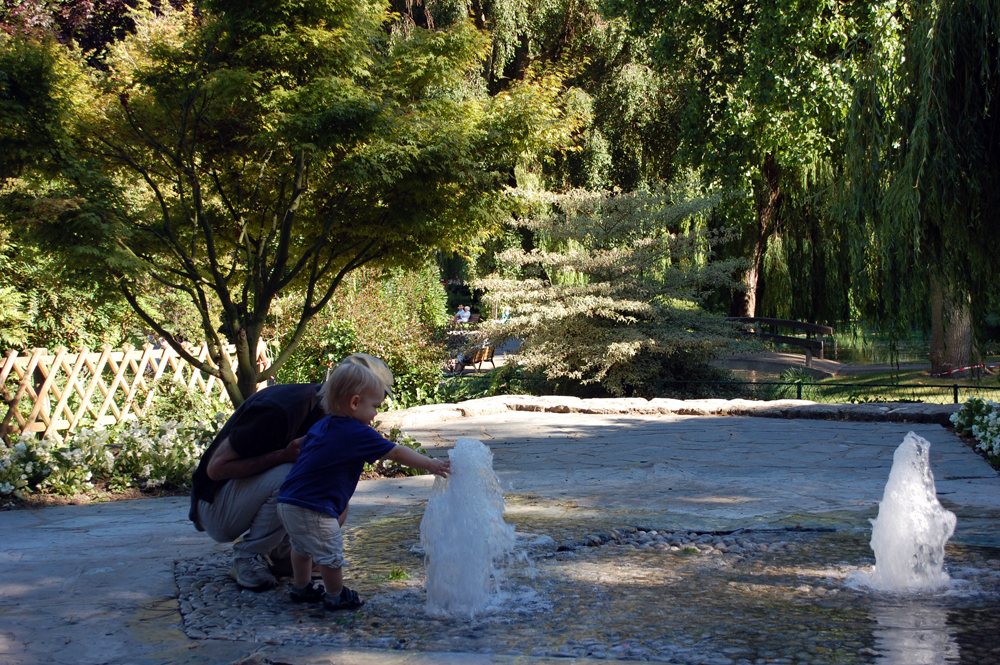
Interactive fountain

The drive home through the Normand countryside was an excellent end to a week of full-on summer. Outside Le Havre are picturesque white cliffs, very much like Dover. The sun slowly sank as we drove south, casting it's last long rays across green hillsides, turning the trees golden and lending halos to grazing horses and cows. It was a pastoral idyll. This time of year night has not completely taken over until well past eleven.

Monday, June 28, 2010

Week 5: Some Pleasures of Summer

Perche Landscape

Summer arrives in France with music in the streets. In 2000, before we moved to France, I spent a summer living with Emily in a rented apartment in the heart of St-Germain-des-Prés and it was there that I first experienced the Fête de la Musique. Begun in 1982 in Paris, it has spread throughout Europe. It is essentially an all night party to celebrate the summer solstice. On almost every street corner musicians of many styles and ethnicities play and sing. Huge crowds gather, mingle, and then move on to the next free venue. No one sleeps! The musicians, most professional, are all unpaid. It is a lively and exciting affair and happens throughout France in the bigger cities.

In our village last year Alain organized a mini version. He is the neighbor who can be seen around town walking on a rhinestone leash either his Chevalier King Charles dog named Barnaby or his pygmy goat named Bernaby. Alain dragged his recorded music collection, huge speakers and disco ball outside Annette's and blasted the village with oompa and accordion music. I don't think he had too many takers. This year, since the 21st was on a Monday, we didn't have the pleasure of his deejay skills. It was silent in Montmirail.

***

A few weeks ago I received a call from a professional photographer named Georges, who lives in Paris and works all over the world for various NGOs. He owns a weekend home outside the village and one day discovered our atelier by chance. He was quite amazed, apparently, to discover that there were photogravure (photo-etching) facilities right here in this tiny hamlet. He was also overjoyed, since photogravure is his hobby and his printer in Paris had just retired. He rang to ask if he could occasionally rent our studio to print his own plates, which are made by Fanny Boucher the only active héliograveur in France. This is a technique ancient and very precise. A photographic image is developed on a copper plate using a photosensitive emulsion. Fanny works with some of the most famous photographers in the world. Her incredible atelier, which we visited a few years ago, is filled with photographic equipment from the early part of the last century, huge sinks, drying racks and dust free rooms, kept clean as a whistle. She works like a scientist.


 This was the week that Georges came with his plates to make some prints. We had a lot of fun working with him as he experimented with different papers, inks and border designs, that he had drawn  onto the paper before printing. He also works a lot with chine collé, gluing decorative papers on the basic printing paper to either create a border around the image, or a decorative surface to print upon. He made print after print and viewed each result with the eyes of a perfectionist, making minute corrections. He had only two images, one of a beautiful young African woman and the other of a  Indian girl. He entertained us with stories of tramping through the jungles of Africa and coming upon tribes of natives who had not been exposed to white men before. He brings his old Polaroid camera with him and takes instant photos which he gives to his  subjects. (His refrigerator is filled with boxes of polaroid film that he bought from New York when it was announced several years ago that this venerable old technology was going to disappear.) The photographic images are, obviously, quite magical to most of the people he photographs, as they have never experienced it before. He typically gives the photo to his subject and keeps the negative, which is what he uses to create his own images. 

Of course I find it inspiring to watch other artists at work. We exchanged techniques, shared supplies and in general had a wonderful time. Tomorrow Georges comes back again, this time with his 11 year old daughter Leyla, who will be taking an etching course from me while her father continues his experimentation. Out of the scores of images he will make in the end, he tells me that he will save only five and throw the rest away.


***

One of the big events in town this week was that the house across from us, owned by Jean-François and Marc had its final coat of enduit put on. There is no English translation for this word, since it means simply "coating" but is a much more specific technique which is not often employed in the United States. Basically lime and sand and water are mixed together and slathered on the outside of a stone building to give a wonderfully rich and colored facing. It's like frosting. The resultant color is entirely dependent upon the kind of sand used and an endless variation of cake-like tones is possible depending upon the source of the sand. Jean-François and Marc have come from their home in Belême (an hour and a quarter round trip) no less than ten times to verify the final color of the house (which is empty but soon to go on the market). They have never been satisfied until this week. The workmen have been trying every sand pit in the locale and were finally able to create the color which approximated what "the boys" (as we call them) had in their minds. This has delayed the project by several weeks, but to excellent effect. The scaffolding has finally been removed and the view out our window now, (once upon a bland dirty tan building with faux cinder blocks painted on the bottom half, as if the real ones aren't ugly enough!) has become apricot. Mme Geudet, the baker's wife and arbiter of all things in the village declared that she was pleased, but did note that it was regrettable that the nurse didn't use the opportunity to resurface her exterior as well. That would have, after all, improved Mme Geudet's view as well. 

The village is going through a certain amount of publically funded improvements. The stone stairs have all been rebuilt, and Celine, the hairdresser, had her building resurfaced a few months ago. The color there turned out a much darker ochre yellow; less pleasing to the local population. In my opinion, however, all these natural colors are beautiful and they weather and mellow with age. I love the variation. The boulangerie, visible from our window just behind the new apricot is a light lemon yellow. They look very good together.

***

Mid-week, we found ourselves with a two-day hole in our calendar, so we took a trip to Paris to see the grandson and stock up on a few specialty art supplies and exotic food items. I also had a sudden desire (it comes over me so seldom) to do some creative cooking. It's particularly enjoyable to do that with Emily. She and I were both long-time Gourmet Magazine loyalists and thus devastated when they suddenly halted publication earlier in the year. Our remaining subscriptions were finished out with issues of Bon Appetite, which frankly both of us consider a much inferior substitute. The "Last Word" in Gourmet gave recipes for various sauces, butters, condiments or vinegars. A keeper every month! In Bon Appetite you get a recipe from a movie star on the last page. Can I care what some famous person rustles up when it's the cook's night off? I do have to admit, however, that the section where readers write in for recipes from their favorite restaurants has resulted in a few extraordinary discoveries. For our guests I routinely follow one recipe I got in my first replacement issue – mushroom cakes served on a bed of avocado gaspacho with a red pepper coulis on top. Makes me hungry just writing about it! This month I found a recipe for chili rellenos stuffed with goat cheese and mushrooms, not to mention one for a cocktail with gin, lemon and grapefruit juices, jasmine tea and limoncello. I imagined a cooking party with Emily, who is quite an excellent and dedicated chef. To make these kinds of recipes one does have to be in the big city, as they contain ingredients impossible to locate at our local markets. In Emily's neighborhood one can find some fabulous ethnic food stores, especially Japanese, Turkish, Israeli and Indian. Regrettably there isn't much in the way of Mexican food or supplies available in France, even in Paris, so we were reduced to visiting Istanbul Market down the road from Emily's to find some anaheim chili substitutes. They worked very well indeed. We had an extended cooking extravaganza and a late but very satisfying dinner together. The second night we ordered take-out.

  The results of Bobo making the mistake of leaving his toast unguarded

We spent a day in Paris center going to my favorite art supply stores. Relma, very close to the Place St. Michel is located in an old Parisian store front. It sells specialty items for book binders. There you find several hundred choices of marbleized papers, leather in every grade and color, wooden book presses in various sizes and beautiful tools for hand binding and stamping. I bought a scalpel there several years ago, it cuts so much more precisely than an xacto knife, and I was finally able to restock my blades. It's not possible to buy them at a pharmacy. I now have a lifetime supply. We walked from there up the quai to Sennelier where they sell more ordinary art supplies, but which offers the art tool addict just as sensual an experience. One enters the old shop by way of a glass door which faces the Tuileries Gardens across the Seine. Inks, pastels, tubes of paints and brushes of every size and shape line the walls from floor to ceiling. Negotiating your way through narrow aisles, jostling with other customers trying to make their own way is a delightful experience. The choices are boggling. After my modest shopping spree was over Rick noted that I seem to find art stores particularly nurturing. It's true. It was a great day. We rounded it off with tapas at a Spanish restaurant near the Jardin de Luxembourg and a visit to a gallery in Montparnasse where they currently have a Chas Laborde exhibition. We walked the whole route. One of my favorite things to do in Paris, is just walk.

Jos and Emily's cherry tree is laden with fruit this year. They cover the ground under the tree and all the neighbors come help themselves. If Quinn is hungry he simply patters outside and picks one up from the ground. He takes a bite and then hands it to you. You remove the pit while he patiently waits, and then you give it back to him to finish.


 a good year for cherries


***
Monique invited us for a Sunday barbecue as the weather has been really heavenly this week and it was a perfect day to sit outside in her secret little terrace garden. Monique lives in a charming house a few steps away. She mans the front desk at the local sawmill, which is owned by her son. She also has two children living on Reunion, so she travels quite frequently. It is extremely pleasant in her lush walled garden. Jonathan and Renata were in town as well as Christine, so the six of us sat at Monique's beautifully-laid table and feasted on five sorts of entrées, a huge platter of four kinds of barbecued meat, potatoes and beets from Jonathan's garden and finally two desserts. Such a meal is a three to four hour affair with lots of lively conversation all around and several bottles of wine. It was a delicious note to end the week on.


***

This week brought people from Belgium, Canada, Germany, Israel, Spain, France and exotically, Ukraine. Who would have guessed that all the world would pass right through the center of Montmirail?


from the garden

Monday, June 21, 2010

Week 4: The World and the World Cup

Ordering Lunch

France, England, Belgium and Germany were represented at the Maison Conti this week. I love the smallness of the European continent. One has the opportunity to be exposed to plenty of different languages and cultural points of view. The distance between San Francisco and Kansas City, to put it in perspective, is about the same as between Paris and Moscow. In the United States we're surrounded by ourselves while in Europe one rubs elbows with all the neighbors. Belgians and Germans often speak multiple languages, and enjoy vacationing in France. Our location is ideal for tourists on their way to Brittany, a favored destination, so we often get stop-overs. This week a Belgian couple, on their way home from the coast, just happened upon our village, parked in front of the house and decided to stay. We often get the opportunity to have long and interesting conversations with our clients, and so we get a picture of the lives of so many different people. The Belgian man is a surgeon and his wife an artist. Their children live far and wide. They enjoyed the studio and imagined coming back for a course. They encouraged us to stop by if we are ever in the Ardennes. If we were to visit all the places we have been invited by former clients, we could have a very extended vacation ourselves! It's really lovely how many of our guests seem more like friends by the time they depart.

***

I can't say that I've noticed much World Cup fever in the village, although Patrice did mention he'd watched the tie between the U.S. and English teams. The French team isn't doing as well as hoped, but it is making some waves! Today the team went on strike in protest of the decision to dismiss one of their teammates for insubordination towards the coach. That's almost unheard of! The French are expert protesters and readily take to the streets when they have grievances. I guess the footballers feel they have the same rights, even in the middle of a tournament! Apparently the French public isn't so interested in the games this year. Of course, if their team were winning it would be a different story. But why waste the emotional energy if the performance is mediocre? I happened to be in Paris ten years ago on the night the French won the European Cup, and I can assure you they are quite capable of unbridled enthusiasm when there's good cause for celebration. I'm not sure if the public is on the players' side in this disagreement or not, but "shocking" was the word used to describe the events on CNN and the BBC.

The British team isn't performing to expectation either. I heard on the radio that the British are considered to be both the best fans in the world and also the most unrealistic about their team's chances. Speaking of British sporting events, I have always loved the comment made by John Cleese when comparing the U.S. to England: "When we hold a World Championship for a particular sport, we generally invite teams from other countries." He was, of course, making fun of our World Series in baseball. World? We've spent several evenings watching the French coverage of the World Cup. I've been enjoying it quite a lot. I'm not usually much of a sports fan, but I've been swept up and it is thrilling to see so many countries playing the same sport in the same location.


***

Our area is particularly well-known for its small organic farms and producers of gourmet products. Within walking distance of our house in one direction we have a farm where they make artisanal goat cheeses in many beautiful shapes and delicious flavors. In the other there is a foie gras producer who makes duck and pork products and gives cooking courses. Sophie, with her husband owns the Enterprise Meulemans. Her mother is quite a talented artist. As a gift, she gave her mother, Sylvie, a course at Atelier Conti. Sylvie spent two afternoons with me and took to etching like a duck to water. She dove right in and started carving away on her zinc plates without a second thought. She was quite brave about dry point, in which no acid or varnishes are used and no preliminary drawing; one just marks on a plate directly with tools as if the surface were a piece of blank paper. Sophie created several nice landscapes.

During the final hours of the second day, I gave her a quick introduction to aquatint and she was able to create this charming little seascape in a very short time.


I inked her plate à la poupée so that she could imagine it in color as well. She was very pleased with her results and so was I.


While she was working I did a bit of experimentation myself. I so rarely work in dry point but I very much enjoyed how direct it can be. I've always loved working with sandpaper, which can be posed on top of the plate and then run through the press to gouge the texture onto the surface. The plate is then inked and voila! I created both the cat and the nude simply by cutting out shapes with sandpaper and impressing them into the zinc.


***

Once a year the Monsmirabilis (marvelous mountain) Association hosts Chevalets dans la Cité (easels in the city). Artists from far and wide come to town to spend a day painting or drawing a scene of our picturesque village. In the late afternoon there is a gathering at the Salle des Fêtes and a panel of judges chooses winners in various categories. The first year we arrived, I was asked to be a judge because I am one of a few other artists who are actual residents. This last Sunday marked my third year on the panel. The day was quite cold, glacial, as Mme Guedet the bouglanger put it, so not very conducive to painting in plein air. Despite that, the quality of the art was higher than usual. I really enjoyed myself. For one thing I talked Rick into accompanying me and that always makes everything more fun. While we were waiting for all the art works to be mounted, Pierre and Odile showed us a book of photographs of the village from the early part of the last century and gave us a commentary about what has changed. Odile pointed out her grandfather and father on one of the pages. Her grandfather was the blacksmith, a tall, burly man. There was a photo of him in front of the old forge from 1917. Pierre and Odile and their son Michel are the backbone of the association. The heart and engine is Samuel, but he wasn't there. It's the first time I haven't seen him at a Monsmirabilis event. Of course, he and his wife no longer even live in town, so I am sure he is trying to encourage others to step into his very large shoes.


Samuel was one of the first people we met when we moved to town. At that time, he ran the local epicerie and, with his wife Celine and three young cherub-faced children, lived next door to the shop. He is French Canadian and so bilingual. He talks to me in French but often writes me emails in English, and is the person I go to with any questions I have. He is extremely patient and generous. Samuel is a very bright and energetic guy and so he sold the grocery business and took a job as a computer programmer in Le Mans. He moved with his family to a town a bit closer to his new employer. This was a huge loss to our village, since he is the main organizer of all the events Monsmirabilis sponsors, but most especially the Medieval Fair in early August. Even though he's been gone from town for almost two years now, he's still the president of the association and the motivating force behind the numerous local activities. Pierre, Odile and Michel with the help of a very few others, do most of the work. I was asked this year, much to my great surprise, to be on the board. I don't often feel as if I have much to contribute, but I'm warming up to it. It's a friendly, lively town and it makes it feel more like home to participate in some of the activities!

Postcard advertisement for the etching class in August, made by Samuel.

Monday, June 14, 2010

Week 3: On the river, in the woods, around the track and of the past

A path through the forest of Montmirail

After a light rain last night, the climbing yellow rose on the front of the house has left its petals strewn across the terrace, as if the bride and groom's recessional had just passed. Instead it was Dena and Bud Allen, who left Maison Conti this morning on their way back to Paris.

But I am getting ahead of myself. The week began under clearer skies and with a visit from grandson Quinn and his family. We pulled down the kayaks, dusted them off after a long winter of disuse, mounted the roof rack and off we went to the nearest lake at Le Plessis Dorin, about five miles away from our home, to give Quinn his first nautical adventure.

We had never seen a boat on the lake before, but there was no sign posted against it. After asking at the cafe across the road if it would be alright to put in, and being told there was no problem, we were just about to launch our kayaks when a fisherman, who with his partners on the far shore had been observing our activities, approached us in a bit of a lather.

"Est-ce-que le maire au courrant?" (Does the mayor know what you're doing?)

"Well, no, not really."

After giving us some grave warnings about the mayor's temper, the private nature of the lake and the necessity of staying away from the fishing zones and wild life preserve, the gentleman suggested that he had not really meant to discourage our adventure. After all:

"Il faut permettre le bon homme d'avoir son expérience de la navigation." (The little boy should be allowed to have his boating experience!)


So we launched, if with just a little less confidence. First Jos, Quinn and Emily and then Rick and I took to the water. It was an entirely pleasant time puttering among the carp, ducks, coots, herons and mating dragon flies. Something about the quality of sound from water level, qualitatively different than street level, has always been particularly enchanting to me.


After our paddle we had a drink at the cafe and there we were officially introduced to the Mayor who happened past. Word of our doings had preceded us, and he approached our table as we sipped cider and Perrier with mint. He seemed much more accommodating and mild-mannered than our fisherman friend had indicated. In fact Emily was able to engage him in a long and productive conversation. He happily gave us his blessing for future discrete paddling on the lake and even suggested he might stop by our studio to see about ordering some business cards from us. 


***
We took a pleasant family walk in a stretch of the woods that I had never explored before, down our hill in a direction I don't generally walk. Quinn met his first horse, who excited and tickled his fancy. He raced up to him without trepidation, and when we showed him how to offer the horse a few morsels of choice grass, laughed as the horse took the bits from his little hand. Jos placed him on the horse's back and Quinn was delighted. 

Quinn encountered a very nice big snail on the road as well, along with a grouse mother and her two babies.We called our walk "Quinn discovers nature." Since he lives in Paris, the countryside is a very big adventure for him.


***
When it comes to revisiting relationships from the distant past, one can never be sure that they will translate comfortably into current life. In the case of Bud Allen, Rick's roommate from boarding school, there was no problem in making the leap. Bud and his wife Dena spent three most enjoyable days with us. Rick's memory of his youth is a bit sketchy, perhaps due to attending just one too many Grateful Dead concerts, so it was quite delightful to find that Bud has retained much from those days in great detail... he could actually recall the very first words Rick said to him:

"Do you dig the Stones? I crave their furry little bods."

Apparently this made a strong impression on Bud and really, no wonder. (Had that been the first thing Rick said to me when I met him, our relationship might have turned out differently.) But of course this must be put in context. 1965, age 15. Bud described the conversation of some of the other students as being a bit like an east coast version of happy days, so Rick's vocabulary was exotic. For Rick, apparently, things were "cool as a moose". Bud reminded Rick that they had discovered the Golden Road to Unlimited Devotion together, as well as Lightnin' Hopkins, the Doors and Howlin' Wolf. What a phenomenal memory bank this man has! And as one of my children once said "Your generation thinks you were the best ever." Well, weren't we? We really enjoyed having Dena and Bud even when we weren't reminiscing about the music and madness of our youth. The days passed quickly.

*** 
This past weekend was the 24 hour Le Mans car race, a time when we're always busy. There is that famous movie with Steve McQueen that I slept through. It involves a lot of cars vroooooooming around and around. I never felt that I missed anything, since every time I woke up the scene would be the same, Steve in the driver's seat negotiating a turn at incredible speed. This is basically the thrust of the thing. The Le Mans race is the oldest endurance sports car race in the world and still the most prestigious. The idea is to build a reliable and fuel efficient car that can take the incredible punishment of 24 continuous hours of driving at maximum speeds. The vehicles can reach up to 250 mph and circle the track over 300 times during the course of the race. Last year Peugeot won, which was a boost to the motherland. This year it was all Audi.


***
I've had several calls for etching courses. Next week the mother of the local fois gras producer is coming to learn a few techniques from me. The following week we have another day student. I was also amazed and somewhat horrified to open up a brochure on summer events in the area and read that I will be giving a lecture on etching in August. I really had no idea I'd signed up for it. This is the danger with having a limited grasp of the language. You sometimes find that you've agreed to things you had no idea about!

  
View of Montmirail from Melleray