Monique's Garden
This week was especially hot, sandwiched between two days of rain to cool things down. On the way to the garden one morning, not knowing if it was necessary to water or not, we met M. Villette, his daughter Martine and her friend, the woman who walks her burro (without a lead) through the village. They were sitting on plastic buckets, harvesting baskets full of red currants. The night before Martine had rung our doorbell just before dark and passed two handfuls of fresh raspberries through the front gate, so we knew she was in town visiting her parents.
"Bonjour, John," said Martine. She always calls Rick the wrong name, but it's gone on for too long now to correct her.
We talked for a few moments about the chances of rain when Martine's friend suggested:
"Demandez de M. Crapaud."
Apparently a large toad (un crapaud) has been living in the same place in their garden for five years, and toads can predict the weather, (and earthquakes for that matter, although that is not an issue in our part of the world). M. Villette lifted the lid to the culvert where the toad makes his home, and I guess M. Crapaud said it was going to rain, since shortly after watering the flowers, we got quite a nice shower. We should have listened to him, but we don't speak his language.
***
Speaking of creatures, the owls that live in the castle tower have been particularly active this week. A pair of beautiful snow white owls have inhabited the castle longer than we have been in residence, and they can often be seen, just as dusk falls, gliding over the castle grounds and wall and passing over our rooftop. The cry they make is between a moan and a screech, and if I were a mouse, that sound would send shivers of dread down my little spine. It is such a mournful call, but one that I love hearing reverberate through early summer evenings.
***
At the beginning of this week, Georges spent two days in the studio printing photos of a lovely Indian girl he had met at an orphanage in Delhi. She is ten years old. The woman who heads the NGO that hired Georges to take photos of the institution was on her way back to Delhi this week, and Georges wanted to send along the girl's portrait as a gift.
We are very happy to have Georges share the studio with us from time to time. He is an entertaining and pleasant addition to our lives, and very easy to have around. He regaled us with stories this time of his childhood. His father owned a restaurant at Versailles when he and his six other siblings were growing up. Their residence was on the Palace grounds and at night, when all the tourists left, his father would take the large key and lock them out and the family in and Georges' family had the entire grounds to themselves.
Georges' eleven year old daughter Leyla came along to take a course from me while her father was doing his own work.
When Georges originally proposed this idea, I was slightly skeptical. I wasn't sure that etching would be something a child would be interested in or even capable of. It has a very fussy side to it, especially aquatint, which requires a certain amount of concentration and the ability to think backwards. Instead it turned out that Leyla was a real natural and enjoyed every minute of the process. She is very patient, creative and focused. I started her out with dry point, which doesn't require using an acid to bite the plate. She learned very quickly. On the first day she made a plate in several stages, inking and taking a proof after each change. In the end she had a sweet landscape with a tree, lake, butterfly, cloud and sun. She printed it several ways, in monochrome, a la poupée and with chine collé, like her father uses. It was a real pleasure to work with her.

Since Leyla was such an apt and enthusiastic student, I decided to introduce her to aquatint on her second day. With aquatint, one works with tones, rather than just line. Leyla wanted to put some text into her design, which is quite complicated since one has to work in reverse on the plate in order for the words to read properly on the print. I was particularly impressed that she had arrived in the morning with a plan for what she wanted to accomplish during the day. She worked very hard to create a drawing, first on tracing paper, and then transferred to the plate with carbon paper. She had created a little shop window full of cakes and breads. She named her shop "The Leyla". (She is a good student of English at school.) She etched the drawing onto a plate and then carefully, and in four steps, added her aquatint tones. A plate like hers takes several hours of work to realize and there is no proof taken until the plate is complete. It seems a very advanced technique for someone so young, but she became an instant pro. All of us were impressed with her charming results.

Leyla and Georges plan to return at the end of July to take up where they left off.
***
We had an opportunity to go to the north coast this last weekend. Emily is touring with her theater company in the Dordogne and Brittany, performing their new cabaret
Improbable Aïda. Quinn is staying in Paris with dad. However, Jos had his own show,
The Art of Laughter, to perform on the weekend in Le Havre and invited us along to watch the boy during performances. That seemed irresistible, so we blocked out the days and took advantage of his offer. We had never seen
Le Havre, and were enticed by the prospect of a couple of days on the beach. The drive north took a little under three hours.
Le Havre was occupied by the Germans during the war and completely flattened by Allied bombs. There is almost no building remaining from before the 1940s. UNESCO has designated
Le Havre a World Heritage Site:
The destroyed area was rebuilt according to the plan of a team headed by Auguste Perret, from 1945 to 1964. The site forms the administrative, commercial and cultural centre of Le Havre. Le Havre is exceptional among many reconstructed cities for its unity and integrity. It combines a reflection of the earlier pattern of the town and its extant historic structures with the new ideas of town planning and construction technology. It is an outstanding post-war example of urban planning and architecture based on the unity of methodology and the use of prefabrication, the systematic utilization of a modular grid, and the innovative exploitation of the potential of concrete.
The results of the reconstruction are strikingly handsome.
We also spent a lot of time on the beach, which is clean and expansive, so one never feels crowded. You can walk for miles through the surf and among multicolored rocks and pebbles, smoothed and polished by the waves. There is everything to do down by the water. People were flying kites, sailing beautiful boats, hang-gliding from the cliffs, bungee jumping, playing handball on courts right on the sand, swimming in a beautiful pool complex that looks out to the waves, or eating at one of the many local restaurants that line the shore. Not to mention walking, jogging or swimming in the warm waters. There are rows and rows of white changing cabins, just like in Jacques Tati's
Monsieur Hulot's Holiday, as well as public outdoor showers to wash off the sand.
Quinn finds a rock to sit on, and discovers surf
Le Havre also boasts the second largest collection of Impressionist art in France - the D'Orsay in Paris, of course, being the first. At the Musée Malraux there was a show of Degas drawings, so we spent part of an afternoon enjoying this very beautiful space and its extraordinary collection of my favorite period of painting.
Musée Malraux, Le Havre
Accompanying Jos was his road manager, a very funny former ballet dancer named el Moustafa, known to his friends as Mous. He was born and raised in Casablanca, which seems incredibly romantic to me. I never knew of anyone besides Bogie and Ingrid who had been there. Morocco is a country I would really like to visit one day. It is apparently a very friendly place. Mous described how the entire city of Casablanca faces the ocean, and how his 82 year old mother swims there almost every afternoon. Mous has lived in Paris for 25 years, but Le Havre is one of his favorite places in France. Perhaps it reminds him of home. He knows the city very well and was our unofficial tour guide.
Le Havre is a walkable city with many public spaces, parks and fountains. We spent an extremely pleasant weekend enjoying perfect weather, excellent company and discovering another corner of France, even though we felt just a little guilty for playing hookie from work!
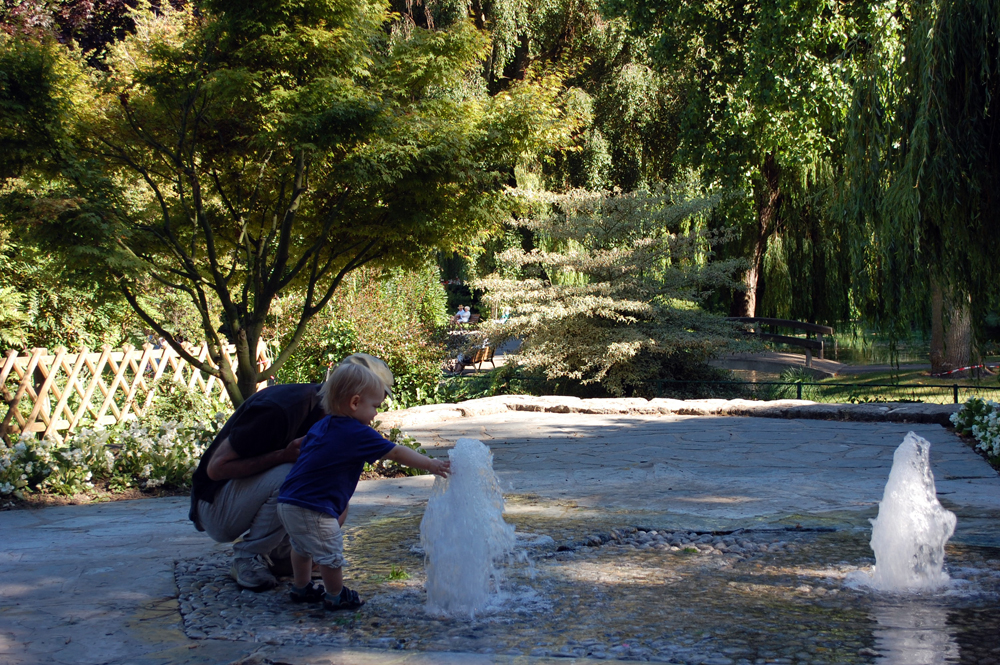
Interactive fountain
The drive home through the Normand countryside was an excellent end to a week of full-on summer. Outside Le Havre are picturesque white cliffs, very much like Dover. The sun slowly sank as we drove south, casting it's last long rays across green hillsides, turning the trees golden and lending halos to grazing horses and cows. It was a pastoral idyll. This time of year night has not completely taken over until well past eleven.